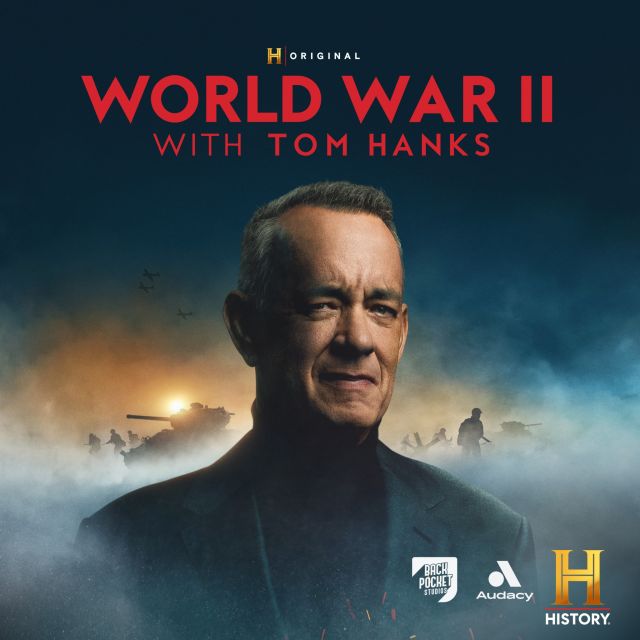
For eighty years, the Second World War has remained the most devastating and defining conflict in human history. World War II with Tom Hanks reexamines the war through the lens of a new century. Told over twenty hours and guided by Tom Hanks, whose lifelong passion for this history has shaped some of the most profound screen portrayals of the era, the series captures the full arc of the war — from the rise of fascism in Europe to the fall of Berlin, from Pearl Harbor to Hiroshima, and the uneasy peace that follows. Each episode uncovers new dimensions of the conflict: the decisions that shaped the battlefield, the unseen networks that sustained the war effort, and the aftershocks that still shape our world today. World War II with Tom Hanks is the definitive retelling of that story for a new generation: a sweeping, deeply human portrait of how the modern world was forged in the fires of global war.
Door The HISTORY Channel | Back Pocket Studios | Audacy
In 1942, the Allies are eager to challenge the Luftwaffe’s superiority in the air. The RAF and U.S. Army Air Forces combine operations to bomb the industrial heart of Germany and destroy German air power ahead of the upcoming Allied invasion of France. Airmen on both sides will suffer grievous losses – and so will civilians below.
This episode features interviews with (in order of appearance):
Robert Citino, senior historian, National WWII Museum
Dan Snow, historian and broadcaster
A.J. Baime, journalist and author
Martin Morgan, military historian and author
John Curatola, military historian, National WWII Museum
Colonel Douglas Douds, professor, US Army War College
Dr. Rebecca Grant, national security analyst
Dan Carlin, podcaster, Hardcore History
Jon Meacham, presidential historian
Anand Toprani, military historian, U.S. Naval War College
In the summer of 1943, after a successful campaign in North Africa, Churchill convinces
Roosevelt that the best way forward is an invasion of the island of Sicily. But what is thought to be a quick and decisive attack instead becomes a months-long slog up the Italian peninsula, as Hitler has no intention of giving up this key part of his empire without a fight.
This episode features interviews with (in order of appearance):
Dan Snow, historian and broadcaster
Robert Citino, senior historian, National WWII Museum
Sarada Peri, presidential speechwriter and political analyst
Jon Meacham, presidential historian
Simon Sebag Montefiore, historian and author
Dan Carlin, podcaster, Hardcore History
Saul David, military historian and author
Colonel Douglas Douds, professor, US Army War College
Martin Morgan, military historian and author
Marco Aterrano, associate professor, University of Naples Federico II
Alexandra Richie, professor, Collegium Civitas
In 1942, Hitlers launches his second offensive in the Soviet Union: Operation Blue. Quickly becoming impatient, Hitler splits his force in an attempt to capture both the Caucasus oil fields and Stalingrad.
Initially successful, the German Sixth Army captures up to 90% of the city until they are trapped by General Zhukov’s men. The Soviet attacks and the unforgiving Russian winter steadily wipe out the German troops until their leader, General Paulus, surrenders. Furious, Hitler launches his final attack, ending all hopes for a German victory on the Eastern Front.
This episode features interviews with (in order of appearance):
Colonel Douglas Douds, professor, US Army War College
Robert Citino, senior historian, National WWII Museum
Sir Antony Beevor, military historian
Alexandra Richie, professor, Collegium Civitas
Sean McMeekin, professor, Bard College
Simon Sebag Montefiore, historian and author
Dan Carlin, podcaster, Hardcore History
Geoffrey Wawro, professor, University of North Texas
Jadwiga Biskupska, associate professor, Sam Houston State University
Amid World War II’s chaos, a hidden battle rages — a war of espionage, deception, and codebreaking. At Bletchley Park, Alan Turing and his team race to crack Germany's "unbreakable" Enigma Code in a bid to thwart Nazi plans and save Britain from invasion. But as the codes evolve, daring missions and deadly risks intensify…
This episode features interviews with (in order of appearance):
Dan Snow, historian and broadcaster
Robert Citino, senior historian, National WWII Museum
David O’Keefe, professor, Marianopolis College
Nicholas Reynolds, historian and former CIA officer
David Abrutat, Official Historian, GCHQ
Sir Dermot Turing, writer and speaker
Matthew Hefler, intelligence historian, King’s College London
Tessa Dunlop, historian and author
Guy Walters, historian and author
Katrin Paehler, professor, Illinois State University
Robert Hutchinson, intelligence historian
In 1942, Eisenhower leads the first joint U.S.-British operation of the war – Operation Torch – successfully landing thousands of untested U.S. troops on the Vichy-controlled shores of North Africa. The Allies race to trap the German forces in Tunisia, resulting in fearsome tank battles against the famed “Desert Fox,” German Field Marshall Erwin Rommel and his battle-tested Afrika Korps.
This episode features interviews with (in order of appearance):
Robert Citino, senior historian, National WWII Museum
Jonathan Parshall, military historian, US Naval War College
General Wesley Clark, US Army, Ret.
Colonel Douglas Douds, professor, US Army War College
Saul David, military historian and author
Dan Snow, historian and broadcaster
Cameron Zinsou, associate professor, Command and General Staff College
Michael Neiberg, professor, US Army War College
Alexandra Richie, professor, Collegium Civitas
Jon Meacham, presidential historian
Under Adolf Hitler's leadership, anti-Semitic policies escalate from discrimination to widespread genocide. The state-sponsored persecution features mobile killing squads conducting mass shootings, and then purpose-built death camps, where millions of men, women and children are murdered by poison gas.
This episode features interviews with (in order of appearance):
Waitman Wade Beorn, assistant professor, Northumbria University
Jadwiga Biskupska, associate professor, Sam Houston State University
Alexandra Richie, professor, Collegium Civitas
Daniel Greene, adjunct professor, Northwestern University
James Bulgin, Imperial War Museum
Rebecca Erbelding, historian and author
Simon Sebag Montefiore, historian and author
Robert Citino, senior historian, National WWII Museum
America’s “day of infamy” at Pearl Harbor is the birth of a new Japanese empire. Japan launches unprecedented attacks across Asia, proclaiming “Asia for the Asians” and pushing out Western colonial powers. Fueled by ideology, Japan’s armies are seemingly unstoppable – until a confrontation with the 1st Marine Division of the United States at Guadalcanal becomes a testing ground in a war without mercy.
This episode features interviews with (in order of appearance):
General Wesley Clark, US Army, Ret.
Jonathan Parshall, military historian, US Naval War College
Robert Citino, senior historian, National WWII Museum
Saul David, military historian and author
Dan Snow, historian and broadcaster
Christopher Harding, cultural historian, University of Edinburgh
Dan Carlin, podcaster, Hardcore History
Takima Melber, the University of Heidelberg
Colonel Douglas Douds, professor, US Army War College
Geoffrey Wawro, professor, University of North Texas
In 1940, German U-boats are sinking British hopes of victory. From the sidelines, FDR loans Britain much needed aid and maneuvers US patrols to the edge of an “undeclared war” with Germany. Meeting at a game-changing summit, Churchill and FDR align their goals. But as America and Britain get closer, so do the German U-boats. Once at war, the US will face not only German ships but the might of the Japanese empire. At Midway, America’s young and inexperienced forces will fight for control of the sea.
This episode features interviews with (in order of appearance):
Dan Snow, historian and broadcaster
Phillips O'Brien, professor, University of St. Andrews
Max Brooks, fellow, Modern War Institute, West Point
Robert Citino, senior historian, National WWII Museum
Jon Meacham, presidential historian
Leah Wright Rigueur, associate professor, Johns Hopkins University
Geoffrey Wawro, professor, University of North Texas
Colonel Douglas Douds, professor, US Army War College
Jonathan Parshall, military historian, US Naval War College
Dan Carlin, podcaster, Hardcore History
Driven by their desire for resources and an Asian empire, Japan invades China. The US joins the global outcry as Japanese troops brutally destroy the Chinese capital of Nanking. FDR responds with a crippling oil embargo, but Japan refuses to back down, propelling them towards an attack on Pearl Harbor that will change the trajectory of WWII and the world.
This episode features interviews with (in order of appearance):
Geoffrey Wawro, professor, University of North Texas
Noriko Kawamura, professor, Washington State University
Takima Melber, the University of Heidelberg
Robert Citino, senior historian, National WWII Museum
Dan Carlin, podcaster, Hardcore History
Colonel Douglas Douds, professor, US Army War College
Christopher Harding, cultural historian, University of Edinburgh
Jon Meacham, presidential historian
Leah Wright Rigueur, associate professor, Johns Hopkins University
Jonathan Parshall, military historian, US Naval War College
Max Brooks, fellow, Modern War Institute, West Point
Operation Barbarossa, Nazi Germany’s surprise invasion of the Soviet Union, launches on June 22, 1941. In what is the largest military operation in history, Hitler aims to capture the Soviet Union’s vast economic resources, enslave its populations, and expand Germany east. It is the beginning of a brutal campaign that will ultimately help decide the war in Europe.
This episode features interviews with (in order of appearance):
Simon Sebag Montefiore, historian and author
Sean McMeekin, professor, Bard College
Colonel Douglas Douds, professor, US Army War College
Alexandra Richie, professor, Collegium Civitas
Robert Citino, senior historian, National WWII Museum
Jadwiga Biskupska, associate professor, Sam Houston State University
Dan Carlin, podcaster, Hardcore History
General Wesley Clark, US Army, Ret.
Sir Antony Beevor, military historian
0:000:00
Wij gebruiken cookies voor advertenties en statistieken. Privacybeleid